INTERVIEW: STATIC GHOST


All photos shot by Violetta Leigh on B & W film.Static Ghost is an EBM/Industrial/Body Music artist from Olympia, Washington. His debut full-length album, Breaching Flesh (VERBODEN Records // 2025), is a descent into fractured memory and synthetic control. Coldwave textures grind against EBM frameworks, while industrial rhythms pulse like machinery running just past failure. Recorded in isolation and refined under pressure, Breaching Flesh is a study in weaponized sound.
Upcoming shows:
Wednesday, August 6th // O’Brien’s Pub - Boston, MA
Thursday, August 7th at SYNTHICIDE w/Semantix, virtue_signal & Andi // Bossa Nova Civic Club, NYC
Sunday, October 5th w/Sexual Purity & obli_x_vion // The Funhouse - Seattle, WA
The second time I saw Static Ghost perform was the Saturday evening of the VERBODEN 2025 festival at EBM/industrial night, my favourite. I had spent the Friday working my day job, then transiting across town with a modest rolling suitcase of wares to host a second shift as a purveyor and reimaginer of vintage and antique jewellery (website forthcoming). The market took place in a house museum which preserves the late-Victorian-era life of Vancouver’s first bookbinder.
I sat on the edge of a century-old bed, next to an oak vanity desk and surrounded by porcelain faced dolls, ostrich feather fans, and mannequins in bustle dresses until late in the evening. Then, after a few hours of sleep, I spent Saturday doing the same market. Toward the end, a client came through and asked to hold an Eighties-does-Art-Deco style rhinestone bib necklace (with matching earrings). She held it up and asked no one in particular, should I buy this? My sign, secure on the table, fell over. Everyone in the room looked. She handed me the necklace and I folded it in tissue, then rung up the purchase.
In my twenties, I could back-to-back-to-back double shifts for three days before I hit the wall. In my thirties, I’m down to a solid two, and I’ve learned to look for the wall ahead and slow down before I collide with it.
I made it to The Cobalt (Cabaret) to catch Markus Midnight’s set, then after a few bands felt fatigue begin to weigh and slipped to a nearby bar to wilt across the counter for a spell. That bar often has a bottle or two of “interesting” wine open; I asked the bartender if they had any red. Are you sure? he said. I thought he misheard me, so I said, a glass of red wine, please. He said, are you SURE? I definitely didn’t mishear him, so I asked why? He leaned across the bar and shouted into my ear over the DJ. Our red is shit tonight. I laughed. I’ll have white.
I nursed my glass of white wine, collapsed on a stool, with elbows on the counter (gauche!), then returned to the venue and caught the chains-and-leather theatre of Meldamor and then the hammering dark techno of XTR Human.
After the set, I hit the wall. I found a friend to say goodbye to, at the soundboard in the gloom at the back of the venue, outlined in the red light from the nearby bathroom. You have to stay for Static Ghost’s set. You’ll love it. He said. I can’t make it, I said, I am so tired. Here, he unwrapped the foil from a bar of fruit leather, take this.
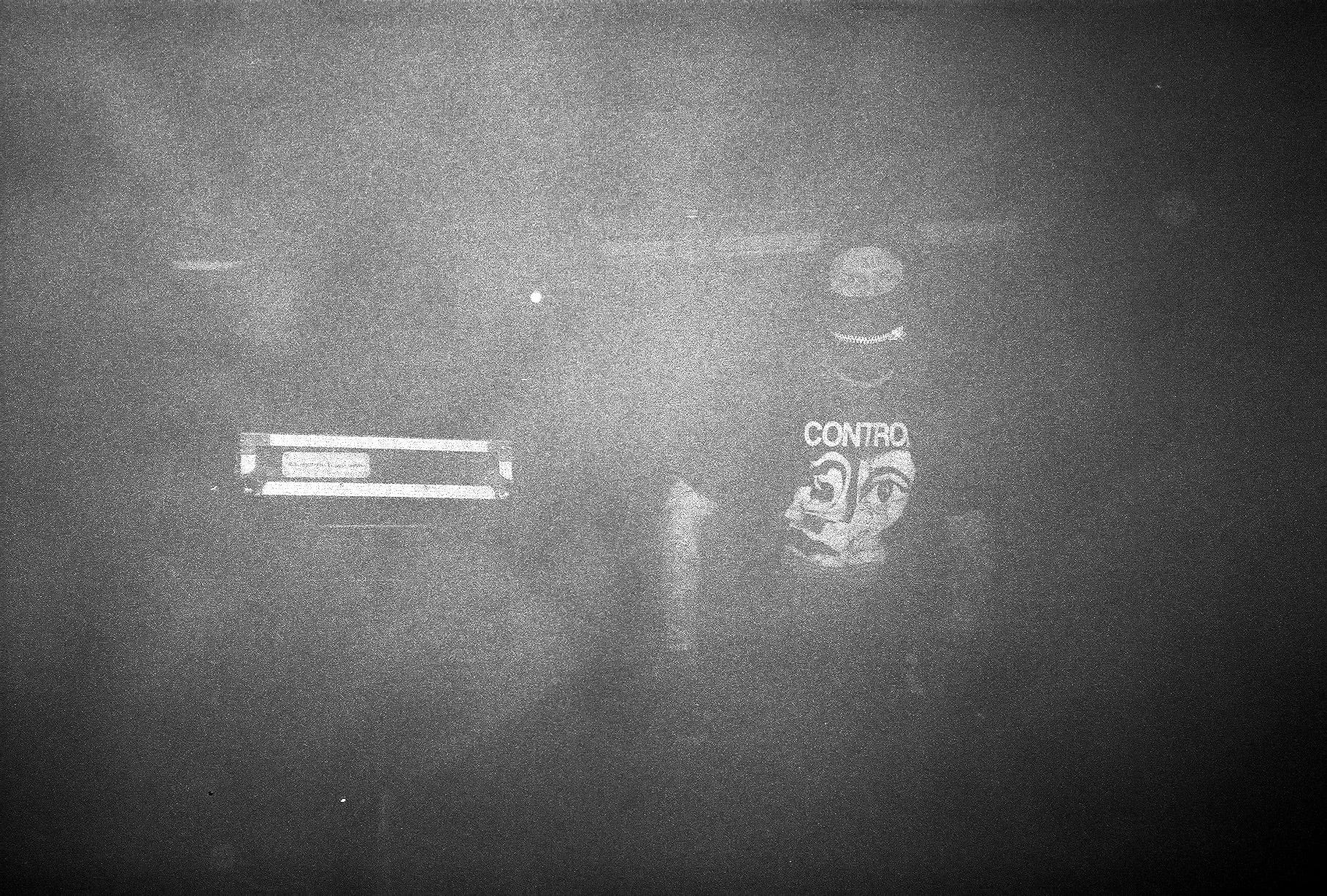
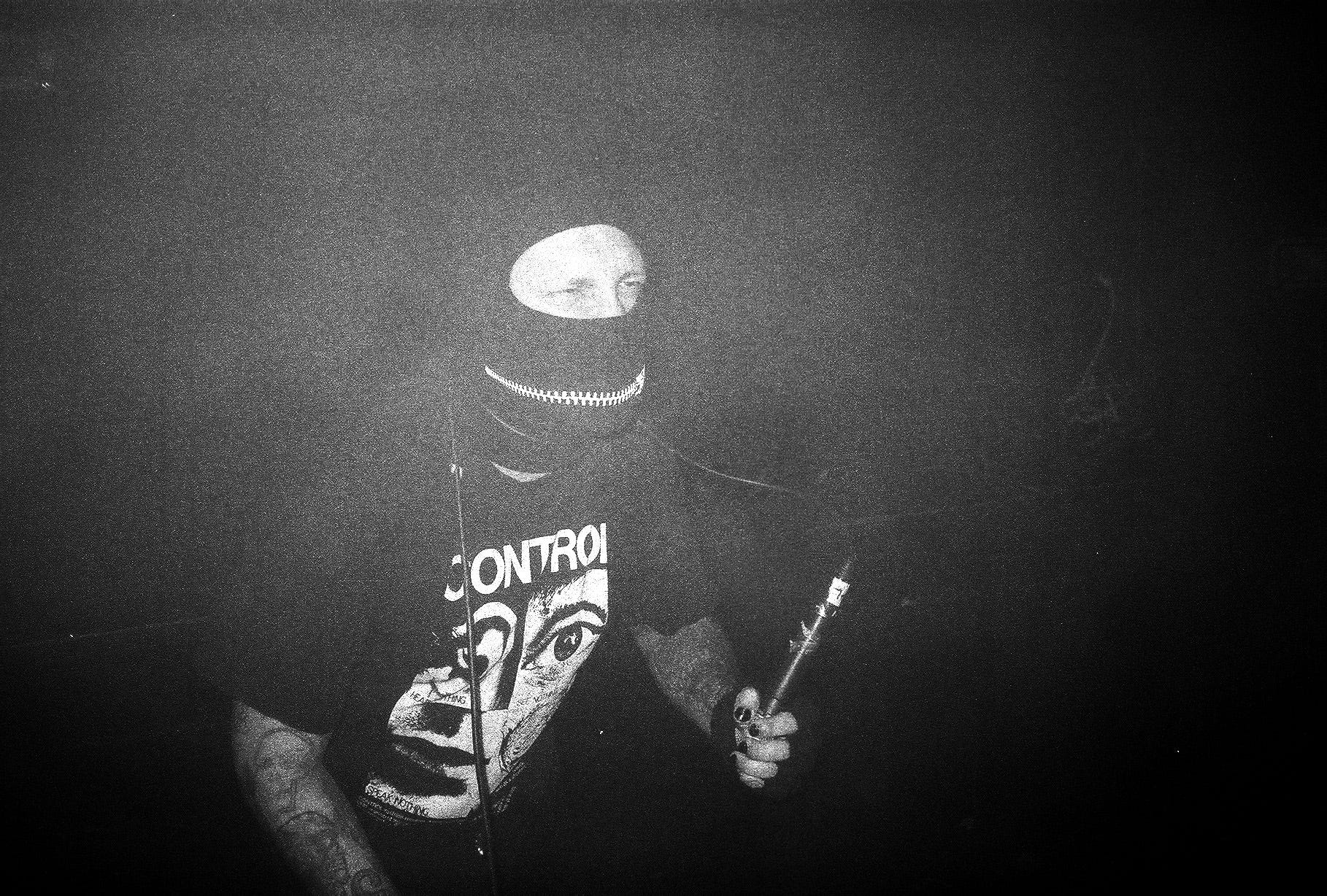
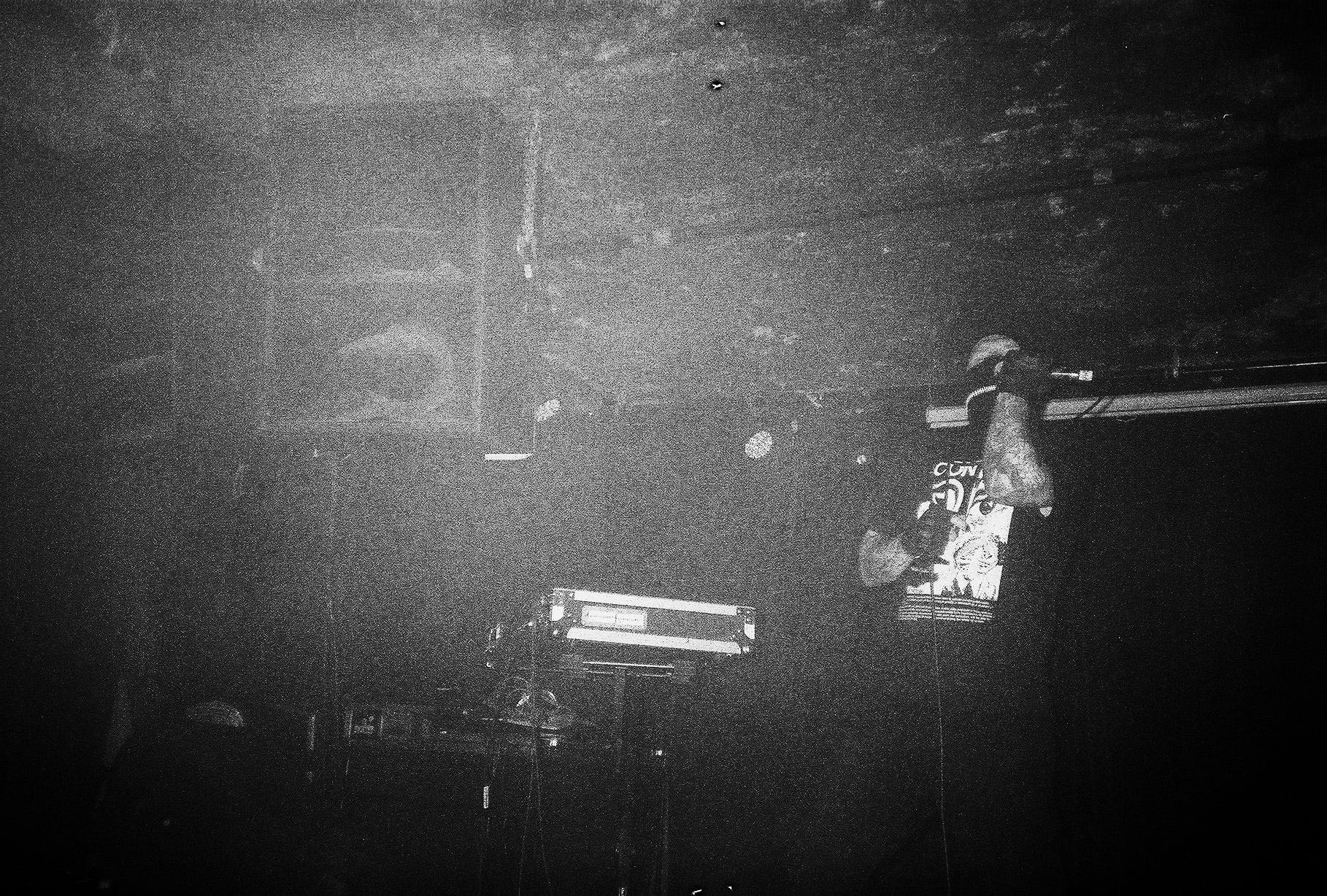
Sustained by fruit leather and arms full of vinyls sponsored by spirit-approved purchases, I angled through the crowd to the foot of the stage. Through an atmosphere of Maximum Legal Fog punctuated by punching bass, Static Ghost crouched at the edge of the stage and shifted a glare from person to person in the crowd.
Unsettling samples looped and blended between vicious danceable beats. It was that combination of energy, confrontation, and reflection that makes an EBM set fun and meaningful, while shaking you our of your daily circuits. EBM commands dance while saying pay attention to the world around you.
On the momentum of violent motion, Static Ghost circled from his table of equipment back to the edge of the stage. This time, he tipped forward and hit the floor so hard that I heard the impact over the music. He didn’t miss a beat. Someone from the crowd stepped in to lift, but he was already up and still on time with the track.
I brought this up at the interview, because I was so impressed – I’ve never seen someone fall that hard and get up again without hesitation.
VL: You didn't even slow down.
SG: I did fall off the stage once and full on ate shit, but I got right back up. It didn't really hurt that bad and I grew up skateboarding - you learn how to fall. I utilized the skateboarding in me, absorbed it, hopped right back up, and acted like nothing happened.
VL: You were completely unfazed and kept going. I think that's more impressive than not falling – you know what I mean?
SG: Totally, totally, well thank-you. That's just from being who I am and having been around all the stuff I've been around. I don't think about it – I ate shit, time to get back up and do it again.
Same with if there's a technical glitch on stage – I don't make it known that something is wrong. If something is wrong, I'm going to navigate it and try to be cool about it. Same with when I fell off the stage. That was not planned. I couldn't see very well –
VL: There was so much fog.
SG: I wanted to get to the edge of the stage and look at people, then I got to the edge, and I was gonna jump but then nope! I'm falling. I still had parts to sing, so I did that, got back up, and then got on stage.
VL: I saw someone come in and try to scoop you up, which was a beautiful thing. That's part of community, that people lift each other up.
SG: That's something that's new for me. In the last couple years of me making music as Static Ghost, I've started making friends in the music community and it's been an actual community. That's an awesome and powerful thing.
I've made music for a long time, but I've never been fully embraced the way that I have been with this project.
VL: I find that especially with niche electronic music, the community is tight knit and generally supportive. Noise scenes, too. Open minded to whatever you're doing – the audience doesn’t go into a show with expectations, they're curious about you and what you're doing.
SG: That's one of the coolest things. Again, I've made music for a long time and it's always been cool, but this time people have really been embracing it and embracing me. I've been able to return that to people and embrace them – it's beautiful and powerful and I'm grateful.
VL: I think it's sustaining, especially right now. Tell me about your new album.
SG: My new album is called Breaching Flesh.
It doesn't have a meaning. It's those words together and the mental images that they paint that I'm attracted to. The combination of words, Breaching Flesh, has EBM references. It echoes classic industrial/EBM naming conventions - visceral, dystopian, confrontational - similar to: Body Rapture (Zoth Ommog comp), Join in the Chant (Nitzer Ebb), and Digital Tension Dementia (Front Line Assembly).
You could view it as the music is breaching your flesh. It's made for you to interact with.
VL: That's the live body music experience.
SG: Exactly, I want the low end to be in your chest. I want that high end to dance around your head and disorient you a little bit. The same with the fog - I like having fog, because I want to hit all of the senses. Not to imply that I'm into manipulating people, but I'm into microdosing the theatrical experience of manipulation and showing the audience, hey, you're being manipulated a little bit.
VL: If I can do this, maybe you're experiencing being manipulated in other ways or other places. We can step out of the accepted perception of our comfort zones and reflect. That's essentially performance art.
SG: That goes back to Throbbing Gristle, Chris & Cosey. I guess there is a little bit of performance art in that, like I said earlier: I'm trying to reflect and show people - hold up a dark funhouse mirror that's a little fucked up, but this is the reality that we live in.
You hear that kick drum. You hear that high hat that cuts through the mix and you start to move your body. You start being told what to do. You start doing it.
VL: Why do we respond to the things we respond to in the way that we respond to them.
SG: Exactly, exactly. I'm not doing it from a place of wanting that power [over people]. I'm doing it from a place of – humans are interesting. The human experience is so unique to everyone, but so collective at the same time.
I think that's something I'm definitely exploring with this music, too, seeing kind of where it all ends and begins.
Another thing that influences me is industrial design. I love industrial design. Specifically, the German company Braun and Dieter Rams, from the 1950s-1970s. Even the [design of] Ableton Push is influenced by Braun and I love that. I love architecture and brutalism, Art Deco – all of that plays into how I structure music and view music.
I've heard Front 242 talk about this. Working on a computer is like architecture for them. That's a beautiful way to view that, because it’s very in line with an industrial designer like Dieter Rams.
VL: Can you share more about how industrial design influences how you structure songs?
SG: Dieter Rams’ design philosophy - especially his Ten principles of Good Design - is a conceptual backbone for how I write songs. His ethos of restraint, clarity, and function-first aesthetics resonates with how I approach composition, arrangement, and sound selection. The songs are machines – built, not sculpted.
Much like Rams stripped everyday objects to their most essential form, I strip my tracks down until only what must remain survives. There is no “filler”. Just as a Braun radio is both beautiful and utilitarian, my tracks aim to be tactile, ergonomic – you feel them in your body before you intellectualize them.
In the same way that Rams designed with space, proportion, and repetition in mind, I build patterns and rhythms that lock into each other with deliberate spacing, which leaves room for tension, collapse, and mechanical groove. I think of a good bassline like a well-made handle: meant to be held, gripped, and used – not just heard.
I’m not trying to make lush soundscapes; I’m designing sonic architecture. Each track is a structure that you move through physically, where vocals are another control interface: clipped, distorted, and functional. Rams believed that good design is as little design as possible. That’s exactly how I think about songwriting: brutal minimalism driven by intent.
VL: When I was conceptualizing questions for this interview, I thought about how industrial music is the exploration between the intersections of technology, humans, and environment. Your songs have unnerving samples about brain washing, government experiments, narrative manipulation, data mining…
SG: Yes.
VL: …and if the birth of industrial music was a response to an age in which access and control of information were becoming the primary tools of power. I have two questions based on that premise. If EBM is the danceable form of industrial music, is this a way for us to process the anxieties of our time through movement with each other?
SG: I think it is. Techno-authoritarianism was an abstract concept in the early eighties, mid-eighties, early nineties, when you had bands like Front Line Assembly and Noise Unit. All these bands talked about this abstract hostile future. It's not like that – it's mundane and scary.
All of this stuff is like the antithesis of who I am. It makes me so angry. Back in the nineties, I was diagnosed with ODD, which is Oppositional Defiance Disorder, and I've always had a problem with authority, especially when it's like authoritarian.
My music is a way for me to get that out in a constructive and healthy way. If I didn't have that, I feel like I would be a lot more angry, depressed, and confused. It's a good way to explore those ideas or thoughts and to make people aware of the batshit crazy environment that we're all in right now. A lot of people might want to escape from that, but now is the time to lean into [reality] more than any other time in the world.
It’s one of those times to get punk rock. I don't see a lot of people doing too much. That's something that I've noticed – a lot of people don't want to shake the tree. They want to live their life of comfort and convenience - that's something that has been kind of indoctrinated.
VL: I feel especially since the pandemic that we've become siloed and have lost a fundamental sense of connection to each other. Coming out of that, it's been paired with third spaces essentially becoming unaffordable or shutting down.
I think that coming together for things like music is crucial to changing course.
SG: I one hundred percent agree. Again, it's a great way to get that stuff out there and to get it out of me. It's wild how many people have come up to me after my sets and been like, I stomped out like all my trauma and aggression. That makes me really happy, because I never thought about it in that way, until people started telling me that that's how they were perceiving it and interacting with it.
It gave me a direction to follow. Like, this is how I feel too. I need to lean into how I actually feel and be a little less abstract. I like to have a little bit of abstraction and a little bit of that old horror movie thing where the villain is more interesting when your mind fills in the blanks. Or, your experiences and what you know about the situation informs how you feel or your perspective.
VL: The uncanny.
SG: That's been something that I've been delving into a little bit more for sure.
VL: It sounds like it's created both meaningful work and connection to other people, which I think are so crucial to happiness or feeling fulfilled.
SG: I totally agree.
VL: For body music specifically, the physical experience of the music is such a part of it.
SG: Yeah, as far as making body music, it has a history that's steeped in the same ideology and the same way of looking at the world that I do. That’s something that I picked up, like when I was a young kid I saw Nitzer Ebb on MTV; we're these English skateboarder guys and we make aggressive electronic music. I was like, I skateboard! Woah, you can make music that's aggressive and electronic, but without a band.
That was my entryway. Then, junior year in high school was all about Front Line Assembly's Caustic Grip, which introduced this abstract idea of totalitarianism. To answer your question, I make body music and I use body music, because I've grown up with it and I love it. I want to contribute in a positive way; it’s not some vanity thing where I'm throwing the word EBM into it.
VL: Just to index yourself.
SG: Right, no. What I'm making comes directly from the lineage of bands like Noise Unit, Front Line Assembly, Skinny Puppy, and Cabaret Voltaire. Stephen Mallinder follows me on Instagram, same with Bill Leeb and I'm like, what the hell? This is crazy!
I've reached out to both of them and been like, thank-you so much for doing what you've done, because I'm standing on your shoulders and without you, I wouldn't be able to do what I'm doing right now. That's also what I like about body music, I get to contribute and be part of something that's bigger than me.
Even when I'm done doing this, it's going to keep moving forward. I love the history of body music. I'm a huge fan and I want to contribute, again: in a positive meaningful way.
VL: I have another question. Industrial music was informed by the sounds of the factory, the physical technology and the bodied labour in those environments. As the technology that shapes our lives becomes formless, is body music an evolution of its predecessor that acknowledges this in its digital composition?
SG: I feel like the adversary is evolving. That's something I talk about in one of my newer songs, No Future. They're watching you; they're selling you. You are a commodity. You and me, that's all we'll ever be. That's what the lyrics are in that song: we're buying you; we're watching you. We are being bought. Our information is bought and sold and traded without our knowledge, because no one reads user agreements and those are fucking insidious.
What's crazy is that people are lining up and signing up for this stuff. They're all for it. It makes their lives comfortable and this and that, but I also feel that it’s removing - I don't want to say it's removing critical thinking - but it's I think it’s dumbing people down.
People don't want to walk across the street and support a local business. They’d rather have a corporation bring it to their doorstep. They don't want to speak up about the shit that politicians in general are doing, because then they’re not going to get their overnight olive oil. My music is critiquing that, as well.
VL: I feel like, in the last ten years, our culture of consumerism has become completely out of control.
SG: It's become like a monoculture around the world of consumerism and just having it now, now, now.
VL: Immediacy, instant satisfaction.
SG: Instant gratification.
VL: It's a concerning cultural shift. I feel that social media is so overstimulating that it keeps you locked out from thinking.
SG: I feel like social media is an extension of reality tv. People on reality tv were horrible and people watched them and said, I'm just like that. It's bred this kind of person that wants fame for existing. It seems like that has transitioned over to the social media world.
It’s weird to see influencers and micro-influencers shilling for some corporation that's making way more money off of them than they're making, but they're getting the adulation, so they don't want to rock the boat either.
VL: I also wonder about the kind of person that reality tv instructs the viewer to emulate. We're shown that being wealthy is the way to be most successful as a human and I think that's a problem. It also has nothing to do with what's on the inside.
SG: Exactly, it's all about the outside and people's perception of you and how you can use that perception to make more money. That's fucked up.
We live in a time where all of these things have been amplified. It feels like it's a good time to make body music, because we're living in times that call for it.
VL: I have a good question for this – by taking audio samples from our cultural narrative and rearranging them, are you creating a response to our institutional narratives—
SG: I am. One hundred percent. You said that better than I could, honestly.
VL: Well, this is the thing that I'm best at.
SG: That's awesome – that's totally something that's on my mind when I'm doing it. I like to explore the concept of absolute power corrupting absolutely. What kind of heinous shit are people capable of when that power is unchecked.
It's not a fascination in a happy way, it's ugly. I like to not be grim and shitty offstage, because I'm not a grim and shitty person; we just live in grim and shitty times.
VL: Bands like Skinny Puppy are seen as dark, but part of their act was performing horrific things that we do to animals on a stage and making that visible.
SG: They're reflecting reality back and that's what I want to do too. I want to show people the reality of things that they're not aware have gone down, through the course of history since the Cold War.
Through the course of time, events leave the collective consciousness. We feel like we're safe now and everything's fine. Then, they’re turned into urban myths, but it was all real shit. People were abducted and experiments like psychic driving were performed on them.
VL: I was going to ask what psychic driving is.
SG: They would play audio loops of people talking or maybe music. They tried to insert false memories. After the psychic driving, they were like, oh shit, we have to do something with them, let's erase their memories. They would expose them to different frequencies or sound to try to erase the memories that they tried to program into their heads.
VL: This is crazy. I've never heard of any of this.
SG: It's super fucking dark. It's wild that we live in a world where that happened. You can keep going back and it gets more and more disturbing – the genesis of this stuff. We start to see it cycle back.
We have to stand up and say, this is wrong. It makes me think of all the horrible shit that happened in the past. We're seeing parallels left and right.
VL: I want to ask you one of my really specific questions. There are themes of weaponized technology in your work and then on your split album with Lan Formatique, Oppressed Memories, you have a track called Gom Jabbar.
In Dune, the Gom Jabbar test of humanity determines whether an individual's awareness is stronger than their instincts.
SG: Yeah, can you control your animal instincts and if you can't control your animal instincts, then you are not the Kwisatz Haderach and you get poked by the reverend mother.
VL: You're not eligible to be a good leader.
SG: Exactly.
VL: With the weaponized technologies of today, is there a character trait that you think would make us resilient?
SG: That's really good. I love, love, love Dune. I love Frank Herbert and I love the books his son wrote.
You know, it's almost like we're the Fremen, we speak a language that the Harkonnens can't understand.
VL: With music? And art?
SG: Exactly.
VL: That's why they hate it.
SG: They hate people accepting one another for their differences. That's something that – I grew up in Tacoma, Washington fighting assholes. I have a mangled hand - like a witch finger - from my youth, fighting and standing up for what I feel is right.
VL: Thank-you for answering my very specific question.
Do you take samples when you're out and about?
SG: Sometimes I will, I'll take samples from old horror movies and action movies. John Carpenter movies are big. There's a movie with Stacy Keach called The Ninth Configuration that I took stuff from. Jacob's Ladder – media that delves into human experimentation and mind control.
I like to reach into movies like that; I like to reach into old documentaries and news clips.
VL: I wondered if you were sampling from news media.
SG: The song Depatterned is about someone who was subjected to MKUltra experiments. They interviewed a bunch of subjects and you can hear the reporter talking, then hear the person talking about their experiences. The experimenter would tell the subject that they were getting smaller and smaller and the person being interviewed thought he was getting smaller and smaller. He also said that if guinea pigs had feelings, then they would know how he felt.
It's wild all the things that the government was doing, from the mid-fifties to the mid-seventies. That's a decent amount of my music.
VL: Did you want to talk about your equipment and technique at all?
SG: We can – I use a lot of old gear and new gear. I like to use the DR-660 from Boss, it's a drum machine that's really big with Memphis rap.
What I love about using the DR-660 in my work is how it bridges this weird, perfect gap between two underground legacies. Most people think of it as a Memphis rap machine – which it absolutely is. Those dusty, skeletal, lo-fi patterns, they’re all over nineties Memphis cassettes.
That same minimalism works for EBM too. Strip away the genre labels and it’s the same logic: take affordable drum machines, loop patterns with surgical intent, and build something hypnotic and heavy.
EBM came from this same feedback loop. Kraftwerk’s Trans-Europe Express influences Afrika Bambaataa, who uses that robotic funk to shape electro and hip hop. Then you’ve got European acts – like Front 242 and DAF – who hear Planet Rock and loop it back into something harder, more militant. EBM is born from that transatlantic exchange – a circuit of repetition, distortion, and recontextualization.
Also, there's an EBM artist from Victoria called Max Renn and he's awesome. I found out about him maybe three or four years ago and reached out: who are you and where are you from? I knew that Max Renn was a Videodrome thing. He said, there was a scene in Victoria, but now there isn’t and that he would return if inspiration struck. The stuff he makes touches on mind control, mass manipulation via the media, the police state and the surveillance state – he was talking about that kind of stuff ten years ago with his music. He uses a lot of the same gear that I do.
I pull from the late eighties, early nineties. Specifically, like Antler-Subway Records – when Antler Records and Subway Records became one and they had bands like Noise Unit and Belgian bands on there. That's the era I pull from.
I use gear like a 909 drum machine and a 303 bass synth. I can't afford to have a Prophet, but I use a Dave Smith TORAIZ As-1. I use a MPC Live II, Alesis Midiverb 1 from the eighties. I try to use old equipment that bands like Skinny Puppy and Front Line Assembly were using, but I also want to use newer gear and update the sound. I want to be respectful to what they were doing. Even though they’ve moved away from that pocket, I want to live in that pocket.
VL: Respect your predecessors, but do your own thing.
SG: Yeah, exactly.
VL: Allan (Flesh Circuit) told me that you like antiquated technology.
SG: I do, I do.
VL: You put out two tapes and a USB – I was going to ask what about physical hardware or antiquated technology do you love?
SG: A lot of the older digital stuff, it degrades over time.
It has this character that you can't emulate. I mean, you can with some software, but it takes so much work. It's almost like how the [black nail polish] on my nails is chipped a little bit. I love that. I love when my nails chip. I love when stuff has a patina on it and has lived a life. I feel like, with music equipment, that patina - even if it's just from your perspective and how you perceive it - it affects that sound.
There was an artist on Instagram who offered services to dust music equipment. People responded with, no, you should leave the dust, because it gives it that old sound. I relate to that. I don't like everything super dusty - because of allergies - but I love old equipment. I also use a MS 20 and I love how over time it has degraded slightly.
VL: It's also a sound that's unique to you as an artist.
SG: One hundred percent.
VL: Things develop a patina based on how you use them and develop a totally unique sound.
SG: Exactly, yeah. That's what I really like. I make a specific kick with an 808 Rumble and a 909 Punch; I've given that kick to some of my friends to make music.
VL: That's nice.
SG: Yeah, I'll hear their music and recognize, that's totally my kick - that's awesome.
VL: It's like a community signature.
SG: I feel like I get a little bit of the old and a little bit of the new. AKAI and MPC have a lineage with EBM and body music, so for what I'm making, they feel like the right instruments to use.
VL: It's the best fit.
SG: I was listening to Rhys Fulber talk about making Caustic Grip. He said that the AKAI S1000 was the sound of that album. That's what I like about that gear: you can fire it up and it has that vibe to it. It's almost intangible – it's hard to put your finger on it, but you hear it.
VL: If you know, you know.
SG: There's some current darkwave or industrial where it's very poppy and I love that stuff. A lot of my friends make very wonderful pop, but I don't want to make that. I want to make something that's got a little more grime and a little more grit.
When I listen to music, I don't want to shut my brain off. Same with movies, I don't want to shut my brain off.
I'm the person, when I watch a movie, I'm three steps ahead. Oh, the director is showing you stuff for a reason, so there's a reason that they're showing this stuff and it's going to play into the second act and then the third act. I'm usually right and I hate it.
VL: I think wanting to be engaged with what you're doing isn't a bad thing.
SG: It’s the same when I listen to EBM, you can hear them play with the bass filter, the cutoff is open, but then they're going to close it when it goes back to the part with the kick drum again. I love that. I love looking at familiar things in an unfamiliar way. That's the thread that ties all of my likes and interests together. I'm an artist by trade – that's what I do for a living.
With art, skateboarding, and music – that's the one thing that ties them all together: looking at something in a way that someone else doesn't and doing something with it that may not have been its pre-designated duty. There is a rigid structure, foundation, and way to do it, but within that rigidity or structure there's wiggle room to impart your personality. Something about that makes my brain do back-flips in my skull.
VL: Art is amazing - especially within the sphere of your own practice - because you get to see a person filtered through a practice that you love. Or, not even a person's perspective, but their whole human experience.
SG: What's great with music and art is that you can use their experience as a springboard for yourself. That's what I said talking to Stephen and Bill; I'm standing on your shoulders. That's how it is with skateboarding, that's how it is with art – everything that I do is informed by the people who came before me.
To move forward, to look back is a good way to be. It may not be everybody's way and that's okay, to each their own, but for me, I like having a little bit of historical context for what I do.
VL: There's an art magazine out of Taiwan called White Fungus. I read an interview where someone said that to make good art you need to acknowledge the genealogy of the art that came before you.
SG: It's true. I don't see a lot of people doing that, but I think that's a me thing - if I get into something, I'm going to learn how to do it. I'm going to learn the history of it. I'm going to learn who did what and why, then I'm going to pick up the information that I have and I'm creating based on how I interact with or perceive that subject matter.
I'm going to do my thing with it, but I'm going to learn how to do it first. Then I'm going to get completely weird.
VL: You learn the rules and then you break them.
SG: Exactly. I've been tattooing for 23 years now and that's one of those things where you have to learn the rules, then you can break the rules and still do something that will be a viable, long-lasting tattoo that won't just turn into a blob after a year.
You're doing it for the now, but you're also thinking of the future. While thinking about the future, I'm also thinking about the past and the people that came before me and all the work that they put into the craft, to be able to get it to the point where I can do what I do.
VL: I think that's really respectful.
SG: Well, thank-you. I interact with everything that way; I think it's my personality.
VL: I think that's a great way to live.
SG: Well, thank-you very much.
VL: Last question, Breaching Flesh has atmospheric tracks like Seeing Self and then harder club tracks like Virus – can you describe the ideal environment to sit down and immerse yourself in the album?
SG: The best way to experience the album is the way that it was designed to be heard: in an underground club or venue. Preferably with a lot of lot of concrete – deteriorated, fucked up concrete would be ideal. Maybe some rebar.
The person that masters my stuff is Alain Paul from Berlin. I go to Alain, because he does stuff for STATIQBLOOM, Qual - he did a lot of Phase Fatale's older stuff. He's done stuff with SARIN on the X-IMG label.
I went to Alain for the mastering of my music, because I wanted to have that character to it. You put the album on and it feels like you're in Berghain or Tresor or some place like those.
You don’t have to go to these world class hard-to-get-into clubs to hear it, but I respect the lineage of those clubs. I think that hearing my music in an environment like that is ideal, because that's where my music originates from.
I played VERBODEN [Festival] in 2024. It was at KWH Studios.
VL: I was there!
SG: I played before Dancing Plague and Renonce that year. A lot of people came this last time I played, [at VERBODEN 2025] because people saw me then. Again, that was underground. I couldn't have fog, because there was no ventilation.
I feel like that's the ideal way - live. If you can't do it live, because I know that costs money and not everyone is into being around a bunch of people, I think that a decent pair of headphones and relaxing in the way that feels best for you.
VL: Headphones and locking in sounds perfect.
SG: I feel like that will augment the experience in a way that makes it a little more enjoyable. If you're in the right mindset to sink into the rhythms you're going to be like, yeah, yeah. I get it.
That’s how I operate. I’m always scanning for patterns, whether it’s in movies or in the world. That instinct drives how I sample: pulling moments that hint at deeper systems – control, violence, decay. EBM has always been about revealing the machinery underneath, and that’s exactly what I’m doing.